


Overview
Located on Oxford Street in Swansea, this refurbishment project focused on the transformation of an existing building within a busy urban setting. The scheme required a façade solution that could bring renewed architectural quality to the property while responding to the realities of working with an existing structure.
Rather than approaching the project as a simple external finish, the façade had to work harder. It needed to improve the visual character of the building, accommodate challenging substrate conditions and deliver a safe, durable envelope that would perform over the long term. For Datum Group, the brief called for a system that could balance the appearance of traditional masonry with the accuracy, adaptability and efficiency of modern façade construction.
Client Challenge
The Oxford Street project presented a series of real-world refurbishment challenges, where appearance, buildability and site constraints all needed to be carefully managed.
Existing façade irregularities
The condition of the existing façade was one of the most significant challenges. The building presented multiple substrates and noticeable inconsistencies across the envelope, making it difficult to achieve the regularity and alignment expected from a high-quality brick finish.
Traditional appearance, modern delivery
The client wanted to retain the character and visual depth associated with brickwork, but traditional masonry would have been difficult to execute consistently across the uneven existing structure. A lighter, more adaptable solution was required.
Fire performance and long-term confidence
As with any modern façade upgrade, compliance and safety were central to the specification. The chosen system needed to provide robust fire performance while also offering durability suitable for the demands of a refurbished urban building.
Access and site logistics
The city-centre location brought additional pressure around access, coordination and disruption. The project required a practical installation approach that could support progress on site without relying heavily on wet trades or complex masonry sequencing.
Benx Solution
To meet these challenges, the Slipfast® Mechanical Brick Slip System was selected for the project.
Slipfast was well suited to Oxford Street because it offered the visual language of traditional brickwork without the limitations of conventional masonry installation. Its mechanically fixed construction allowed brick slips to be securely installed onto a pre-engineered carrier system, giving the project team greater control over alignment, coursing and finish.
This was particularly important on a building where the substrate conditions were far from straightforward. The system’s flexibility helped the installation team accommodate variations in the façade line while maintaining a consistent brick appearance across the elevations.
The lightweight nature of the system also reduced additional structural load, making it a strong fit for refurbishment. At the same time, its A1 non-combustible classification provided the fire performance required for a safe and future-ready façade solution.
By reducing reliance on traditional wet trades, Slipfast also helped simplify the installation process. This supported productivity on site, reduced programme risk and allowed the team to work in a cleaner, more controlled way despite the challenges of the existing building.
Visual & Design Commentary
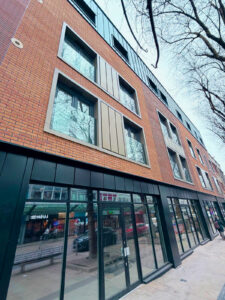
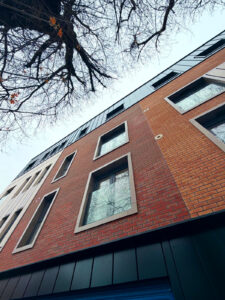
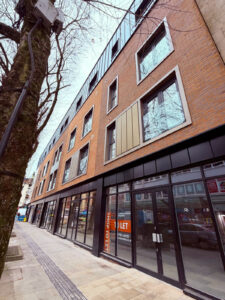
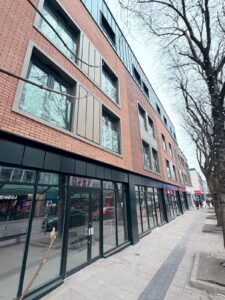
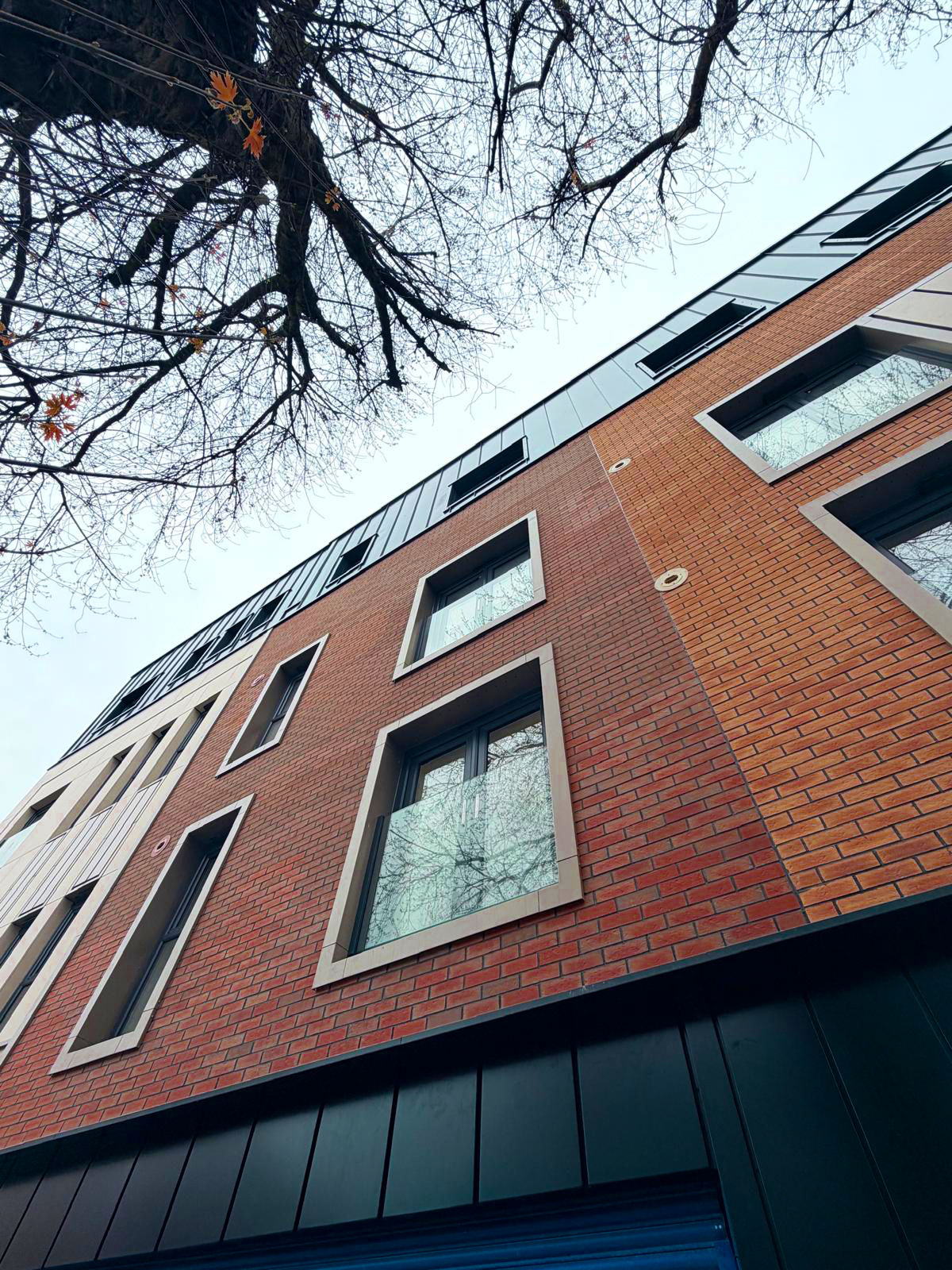
The completed façade gives the building a sharper and more coherent street presence. The brick slip finish provides the familiarity and texture of masonry, while the precision of the mechanical system helps bring order to what was previously an irregular and challenging envelope.
The success of the project sits in the alignment. Across the elevations, the brick coursing needed to feel consistent and deliberate, despite the uneven conditions behind the finished face. Slipfast allowed the installers to manage those variations without compromising the visual rhythm of the façade.
Around openings, corners and transitions, the system helped create a more controlled finish. The result is a façade that reads as traditional brickwork from the street, but is supported by a modern installation method behind the scenes.
Outcomes & Performance Highlights
Aesthetic consistency
The project achieved a high-quality brick finish across a difficult existing structure. The Slipfast system allowed the façade to retain the character and texture of masonry while delivering a more precise, consistent and refined appearance.
Refurbishment suitability
Oxford Street is a strong example of how a mechanically fixed brick slip system can unlock possibilities on refurbishment projects. Where traditional brickwork may have struggled with substrate irregularities, Slipfast provided the flexibility needed to adapt to the building.
Fire performance
The A1 non-combustible classification of the system supported the project’s compliance requirements and gave the client confidence in the long-term safety of the façade build-up.
Installation efficiency
By limiting the need for wet trades, the system helped streamline works on site. This was particularly valuable given the access challenges, urban location and condition of the existing building.
Reduced programme risk
The mechanical installation approach allowed the project team to maintain accuracy and progress in demanding conditions. Careful coordination, combined with the adaptability of the system, helped the scheme meet programme requirements and achieve the client’s expectations.
Conclusion
The Oxford Street refurbishment demonstrates how modern façade technology can support complex existing buildings without compromising architectural intent.
Through the use of Slipfast, Datum Group were able to overcome severe substrate irregularities, reduce installation risk and deliver a façade with the appearance of traditional masonry and the performance benefits of a modern, mechanically fixed system.
The finished building now has a stronger, more consistent visual identity, supported by a durable and compliant façade solution designed for long-term performance.